How Can Japanese Knotweed Scupper a Mortgage?
Advantage clients Davide and Rocio have finally moved into their new home – but getting there was far more stressful than they had anticipated.
Their purchase had progressed well, their mortgage offer had been produced and everything appeared to be on track. Then, late in the process, a potentially serious issue came to light: a neighbouring property had previously been treated for Japanese Knotweed.
Cue a tense few weeks of uncertainty.
So, how can a plant that grows in your garden potentially cause a mortgage application to grind to a halt?
How can a plant scupper a mortgage?
Japanese Knotweed is an invasive plant species that has become a particular concern for property owners, buyers and mortgage lenders in the UK.
It spreads through an extensive underground root system known as rhizomes. The plant dies back during the winter, but comes back strongly in spring and can grow extraordinarily quickly during the summer – in favourable conditions, growth of more than 10cm a day has been recorded.
That rapid growth is part of the reason Japanese Knotweed has developed such a formidable reputation.
There is, however, a common misconception that Japanese Knotweed is capable of growing through concrete, foundations and other structures simply because it is exceptionally strong.
That’s not quite accurate.
Japanese Knotweed isn’t necessarily more capable of physically penetrating sound concrete than other plants. The problem is that its extensive root system can exploit existing cracks, gaps and weaknesses in buildings, paving and other structures. Once it finds an opening, its rapid growth can make an existing problem significantly worse in a relatively short period of time.
In other words, it isn’t necessarily that Japanese Knotweed is uniquely destructive – it’s the combination of its extensive root system, rapid growth and ability to exploit existing defects that causes concern.
Why are mortgage lenders concerned?
For a mortgage lender, the condition and value of the property securing the loan are extremely important.
If Japanese Knotweed is identified at, or close to, a property, a lender may have concerns about:
- Potential damage to the property or surrounding structures
- The cost and effectiveness of treatment
- Whether the infestation could return
- The impact on the property’s future saleability
- Whether appropriate insurance or guarantees are in place
- Whether a professional treatment plan has been carried out
- The potential impact on the property’s value
This doesn’t necessarily mean that a property affected by Japanese Knotweed is unmortgageable.
Far from it.
However, the presence of Japanese Knotweed can result in additional questions being asked by the lender and, in some circumstances, further information being requested from the valuer or a suitably qualified specialist.
And that’s exactly what happened to Davide and Rocio.
A late-stage Japanese Knotweed scare
Davide and Rocio only discovered that a neighbouring property had previously been treated for Japanese Knotweed after their mortgage offer had already been produced.
Understandably, this was particularly worrying.
The neighbouring property had in fact been treated, and the treatment had subsequently been inspected. However, there were questions surrounding whether the appropriate insurance arrangements were in place.
This meant that, despite the purchase otherwise being ready to complete, the mortgage lender needed to refer the information back to the valuer for further consideration.
The result?
Weeks of uncertainty while everyone waited for the situation to be resolved.
When you’re buying a home, the final few weeks before completion can already be stressful enough. Having an unexpected issue involving Japanese Knotweed appear after the mortgage offer has been issued is certainly not something any buyer wants to deal with.
Thankfully, the lender was ultimately satisfied with the information provided and everything was agreed.
Davide and Rocio finally got the keys and moved into their new home – albeit later than originally planned.
Another mortgage completion, another happy client, and a good reminder that property purchases don’t always go entirely according to plan!
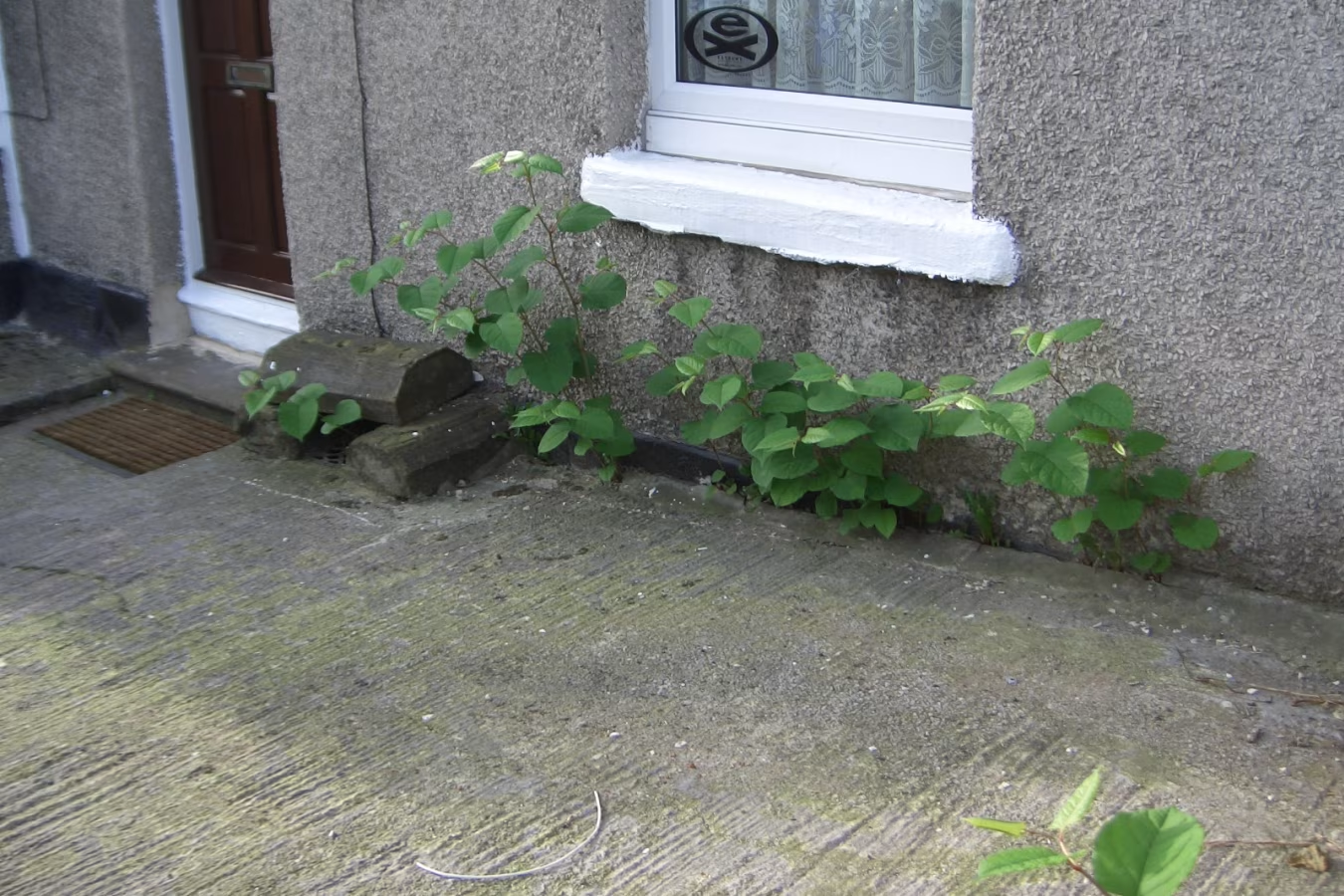
I’m worried that I might have Japanese Knotweed – what does it look like?
One of the problems with Japanese Knotweed is that it doesn’t look particularly frightening.
It isn’t an exotic-looking plant that immediately screams “danger”.
In spring, the new shoots can look a little like reddish asparagus. As the plant matures, the stems become more bamboo-like, while the leaves are generally bright green and have a distinctive shape.
During the summer months, it can grow very quickly and can become a substantial plant.
If you notice a weed-like plant growing unusually rapidly from a seemingly small gap or crack, particularly close to a building, wall, patio or other structure, it is worth investigating further.
Don’t pull it up yourself!
If you suspect that you have Japanese Knotweed, one of the worst things you can do is simply start pulling it up or attempting to dig it out.
Japanese Knotweed is notoriously difficult to eradicate and disturbing the plant or its root system can potentially make the problem worse by spreading fragments of the plant.
Professional treatment is generally the safest approach.
A specialist can identify the plant, assess the extent of the problem and recommend an appropriate treatment programme. Depending on the circumstances, treatment can take time, so early identification is important.
What should I do if I’m buying a property and Japanese Knotweed is discovered?
If Japanese Knotweed is identified during the purchase of a property, don’t immediately assume that the purchase has fallen apart.
The important thing is to establish exactly what has been identified and where it is located.
The lender may want to see evidence of:
- A professional survey or assessment
- An appropriate treatment plan
- Evidence that previous treatment has been completed
- Any relevant guarantees or insurance
- Information regarding the distance between the plant and the property
- Confirmation from the valuer that the property remains suitable security for the mortgage
Different lenders can have different requirements, so this is one of those situations where getting the right information to the lender is particularly important.
This is also why it’s useful to have a mortgage broker involved who can communicate with the lender and help establish what information is required.
The lesson from Davide and Rocio’s toil?
It was ahappy ending for Davide and Rocio, see the obligatory ‘keys in hand’ picture below.
But their experience highlights an important point for anyone buying a property:
Unexpected issues can appear at almost any stage of a property purchase – even after your mortgage offer has been issued.
Japanese Knotweed doesn’t automatically mean that a property can’t be mortgaged, but it can create additional complications and delays.
If you’re buying a property and something unexpected has been identified by the surveyor, valuer or seller, speak to your mortgage broker as soon as possible.
The earlier the issue is understood, the more time there is to find a solution.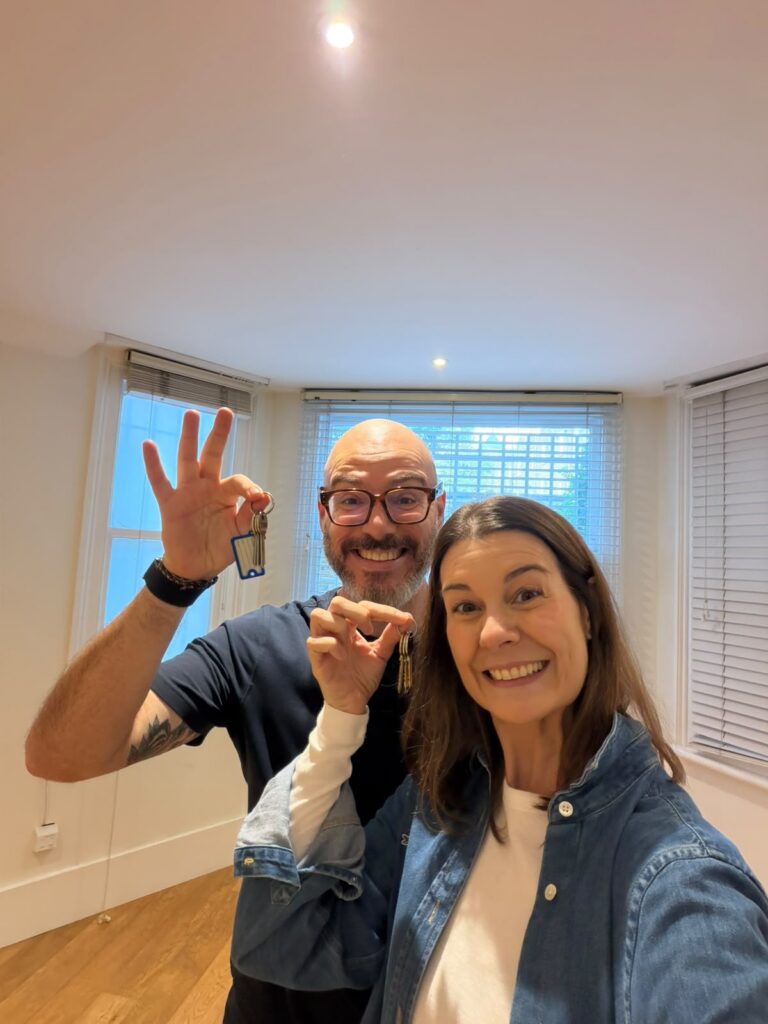
Buying a property?
At Advantage FS, we help clients navigate the mortgage process from initial application through to completion – including those occasions when something unexpected threatens to derail the process.
If you’re buying a property and have concerns about Japanese Knotweed, or you’ve been told that it could affect your mortgage, get in touch with the Advantage FS team and we’ll help you understand what your options are.
Please note: the information in this article is intended as general guidance and should not be considered legal, surveying or specialist Japanese Knotweed advice. Individual mortgage lender requirements can vary.